

Skip to main content
Left: Valve outside being worked on. Middle: Location of worker exposed to H2S. Right: H2S release location.

How Does It Work / What Was Supposed to Happen?

  • Acid gas from the amine regenerator flows to the acid gas injection system, where the gas stream is split between two identical acid gas compressor packages.
  • Each compressor package includes a 5-stage, 2000 horsepower acid gas compressor, which compresses the incoming gas from approximately 50 kPag to 6200 kPag.
  • The high-pressure, dense-phase acid gas is then injected into the well via a pump.
  • Acid Gas Unit 2 was scheduled for maintenance.
  • The Unit 2 acid gas compressor and pump were locked out for 8000-hour service and control valve packing upgrade.
  • The unit was purged with sweet gas and zero energy was verified in accordance with the Energy Isolation Checklist (EIC), which tracks each energy isolation point in the isolation process. Purging can typically take 8-12 hours.
  • Instrumentation personnel were tasked with upgrading the control valve packing during the outage.
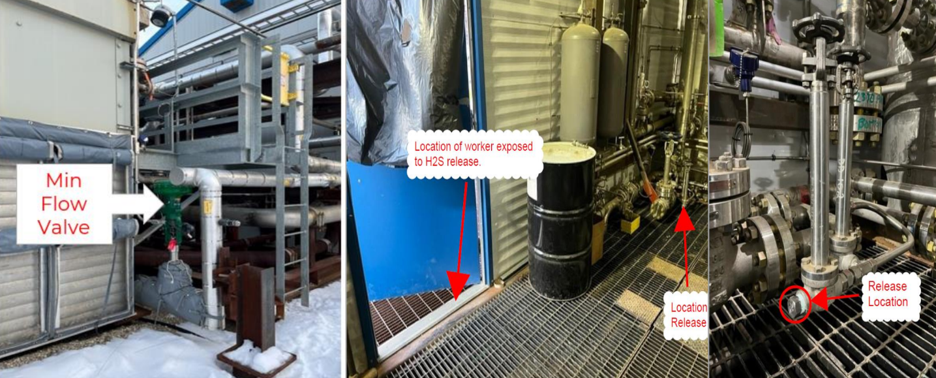
Event Overview:

While performing maintenance on a control valve located outside the acid gas building (Unit 2), trapped sour gas was released from the zero-energy check point inside the building, resulting in worker exposure to H2S.
The release was detected by the acid gas building gas detection system at 30 ppm and also activated the exposed worker`s gas monitor, which recorded up to 41.9 ppm.

What Could Have Happened?
  • Release of sour gas with H2S concentrations potentially >100 ppm
  • Worker exposure to H2S could have resulted in a fatality
  • H2S Immediately Dangerous to Life and Health (IDLH) = 100 ppm
  • Immediate unconsciousness and possible fatality = 500-700 ppm
What Happened:
  • An instrumentation technician began work on the minimum flow valve located outside the acid gas compressor building.
  • While preparing to work on the control valve, the technician removed the control valve air supply, which caused the minimum flow valve to fail open.
  • Trapped sour gas between the minimum flow valve and check valve was released (98 kPa), resulting in an H2S release inside the building and exposing a worker.
  • H2S readings of 30 ppm were detected by the fixed building gas detection system, activating emergency horn and beacons.
  • The personal monitor of the worker nearest the release point recorded 41.9 ppm H2S. The worker was not wearing respiratory protection, as the system integrity had been previously broken and proven safe.
  • All workers evacuated and safely mustered.
  • The exposed worker was assessed by on-site safety medic.
Event Details - Purging Cycle:
  • The minimum flow control valve was opened to complete the purge cycle.
  • The minimum flow valve was left open until the pump and related piping were completely depressurized.
  • Once the purge cycle was completed, operations began depressurizing the compressor.
  • The minimum flow valve was closed.
  • Low residual pressure was inadvertently trapped between minimum flow valve and check valve.
  • The energy-free check was completed upstream of trapped pressure.
What Did We Learn?
  1. The minimum flow valve was not captured in the Energy Isolation Checklist and the requirement for the minimum flow valve to remain open prior to zero-energy check was not identified in the purge procedure.
  2. The current document control process and Energy Isolation Checklist completion process are not stringent enough and allows for gaps within the process. Example: An EIC document may be stored on a desktop, allowing for an out-of-date document to be used.

Learning Before Serious Harm

Our 2019–2024 PSI Report analyzes industry-submitted incidents to highlight patterns and risks with the highest potential for serious outcomes—supporting learning before harm occurs.

Learn from Past Events

Explore Safety Alerts to see how incidents occurred and what can be done differently. Applying lessons from past events helps workers and leaders recognize hazards before they lead to serious harm.

Related Learning Opportunities

Share: