
Skip to main content
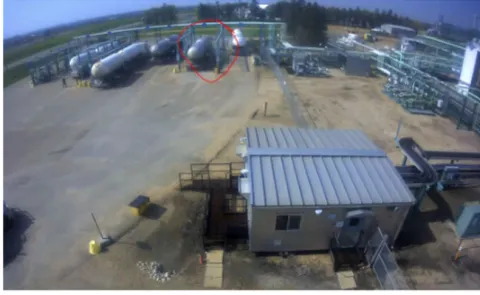
Truck rack and event location

Incident Description:

  • A truck driver was unloading natural gas liquids (NGL) at Rack 2 of the truck rack facility.
  • The vapor hose used for offloading failed during the last ~10 m3 of the product transfer.
  • The truck rack went into an emergency shutdown (ESD) due to high %LEL detected at Rack 2.
  • There were no drivers or other workers present in the immediate area at the time of the hose failure.
  • The driver was able to safely isolate the system.
  • All workers at the truck racks evacuated to muster areas and awaited direction from operations, as required.
  • The system pressure was 1280 kPa (~185 psi) at the time of failure.
    • The maximum allowable working pressure (MAWP) for this hose is 250 psi.
    • The hose was pressure tested to 375 psi by the manufacturer prior to being put into service.
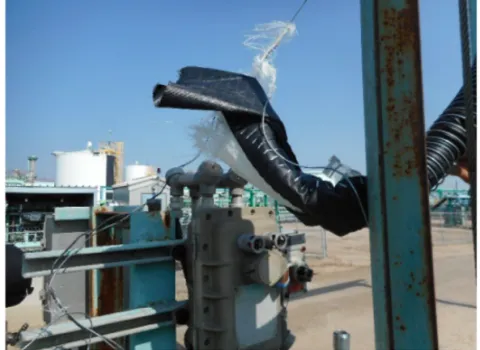
Hose condition in location after the event
Contributing Factors / Event Learnings:
  • The hose was inspected by two separate third parties post-incident to find a cause of the failure.
  • The hose was originally supplied by a company who assembled and performed the initial certifying pressure test.
  • The failed hose was sent back to the supplying company for inspection and failure analysis. Their conclusions are as follows:
    • The crimp diameter of the failed end and fitting was crimped to specification.
    • The damage to the hose and wire displacement is much greater than is possible from a blown-off end. Typically, if an end were to blow off, it would pull 6", and the pressure would dissipate. In this case, there is ~5 ft of inner/outer wire pulled from the hose—much more than expected.
    • The hose has a burst pressure of 1,000 psi (4:1 safety factor) before any damage to the integrity of the hose or the end ejecting.
    • These hoses are tested to 375 psi for 5 minutes once assembled. Any manufacturing defects would be found during the original test.
    • If there was no pull-away prior to the failure, the hose must have been damaged by some other means prior to the incident.
    • There is no logical explanation for this failure, other than unknown human error.
  • Another third party was consulted to provide further independent analysis. Their response is as follows:
    • Composite hoses are built differently by various vendors, therefore, checking the crimp specification would not be of value.
    • Two scenarios were identified as possible causes of the hose failure:
      • The pressure was too extreme, and a major blowout failure occurred.
      • As previously mentioned by the other third-party company, it was somehow torn away.
  • This company hypothesized that installation practices may be a contributing factor in damage to the crimp fitting.
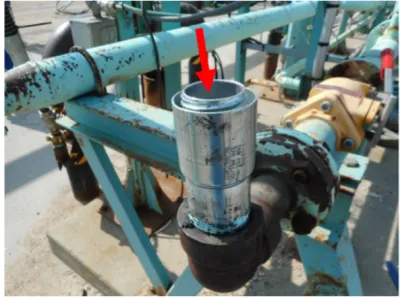
Hose separated from the crimped fitting
Known Factors That Conflict with Third-Party Findings:
  • The system pressure was 1280 kPa (~185 psi) at time of failure, well below the hose MAWP.
  • The truck was stationary at the time of failure, therefore, it was not “torn away”. Video evidence supports this.
  • It is believed that the noted damage to the end of the hose resulted from the violent whipping action of the hose until flow was stopped and pressure dissipated.
Required Actions:
  • Installation practice review to be conducted to confirm if it stresses and weakens the crimp joint.
  • Initiate a Management of Change (MOC) to consider alternate connection joints that may be more appropriate for the application.
  • If similar hose connections are in use at your facility, ensure they are being installed and inspected as per the manufacturer’s specifications and instructions, as certified by a professional engineer.

Learning Before Serious Harm

Our 2019–2024 PSI Report analyzes industry-submitted incidents to highlight patterns and risks with the highest potential for serious outcomes—supporting learning before harm occurs.

Learn from Past Events

Explore Safety Alerts to see how incidents occurred and what can be done differently. Applying lessons from past events helps workers and leaders recognize hazards before they lead to serious harm.

Related Learning Opportunities

Share: