

Skip to main content
Excavator Contacts De-Energized Overhead Powerline

Incident Description:

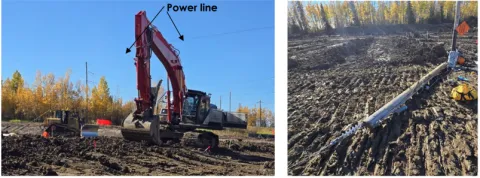
The civil contractor was working on constructing the clay base for the new control room pad. The excavator was cleaning up the north side of the pad, working from the NE corner west towards the site access road. Crossing this section of the pad is a de-energized overhead powerline.

The equipment operator worked their way across the site, under and past the overhead de-energized line. Once at the access road, the operator stopped, swung the machine, and began travelling back to the NE corner. While travelling, the boom of the excavator was raised (see Photo 1) and contacted the overhead de-energized line. The tension from the contact caused the utility pole on the pad to break, bringing down the line and a transformer atop the pole.

Contributing Factors:
  • The utility pole and de-energized line were intended to be removed prior to the start of the civil scope; however, due to some miscommunication between the company and the utility provider, this did not occur.
  • Due to the live electrical hazard being eliminated, the risk of contact with the de-energized line was not adequately assessed.
  • Additional visual controls (i.e., rope and ribbon) to mark the exclusion zone were NOT utilized, as the additional posts were deemed to be more of an obstruction than benefit.
  • The contractor workers were “tunnel visioned” on their tasks and the equipment operator failed to recognize that the equipment was within the 7 m zone of the overhead line. There was no spotter in the area at the time of the event.
Similar Events in Previous Years:
  • 2017: A mechanic accessed a lease that was not covered under the safe work permit to conduct repairs on a tree processor. The boom was in the curled position when it contacted and severed a live powerline.
  • 2017: A worker was using a telehandler to transport a roll of liner rigged to the machine’s extended boom using a sling. The worker entered the work site using a temporary access point that passed under powerlines. The telehandler contacted the overhead powerlines, which were identified as de-energized after contact was made.
  • 2022: A clearing crew was using chainsaws to clear trees. As the crew was cutting a tree, it landed on the powerline. A spotter was in place. All work was stopped, the area was cleared immediately, and a third-party rep was contacted. There was no disruption to service. No injuries occurred; minor damage was noted on the cross-arm to the closest pole.
Required Actions:
  • Reminder: In Alberta, the safe working distance from overhead powerlines is 7 metres. If working within 7 metres of the powerline, the utility owner must be contacted prior to work starting for approval and instruction.
  • When working near overhead powerlines (live or de-energized), always ensure the use of goalposts and a spotter.

Learning Before Serious Harm

Our 2019–2024 PSI Report analyzes industry-submitted incidents to highlight patterns and risks with the highest potential for serious outcomes—supporting learning before harm occurs.

Learn from Past Events

Explore Safety Alerts to see how incidents occurred and what can be done differently. Applying lessons from past events helps workers and leaders recognize hazards before they lead to serious harm.

Related Learning Opportunities

Share: