Skip to main content

THE INCIDENTS THAT HURT PEOPLE AREN'T ALWAYS THE INCIDENTS THAT KILL PEOPLE.

Preventing Serious Injuries and Fatalities Requires a Different Approach

Alberta's energy industry has made significant progress reducing injury frequency. Yet serious injuries and fatalities continue to occur.

By the end of 2025:

9

Workers lost their lives

125

Workers experienced serious, life-altering injuries

134

Lives permanently changed

Traditional safety measures help us understand how often injuries occur. Serious Injury and Fatality (SIF) prevention helps us focus on the events with the greatest potential for harm.

PROGRESS WORTH RECOGNIZING

Safety Performance Has Improved. The Challenge Has Changed.

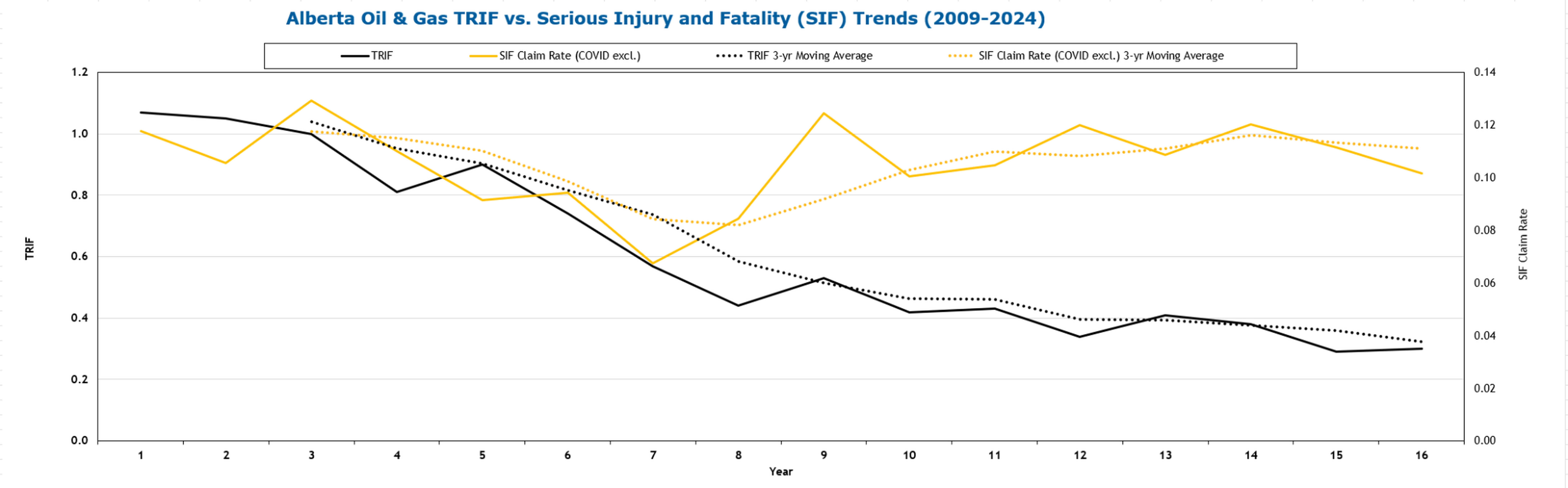
Over the past 15 years, Alberta's Total Recordable Injury Frequency (TRIF) has declined by more than 70%.
That progress reflects the commitment of leaders, workers, contractors, and operators across the industry. It represents years of focused effort, investment and learning.

But while injury frequency has improved, serious injuries and fatalities have not declined at the same pace.

TRIF vs. SIF trends graph

The industry's next challenge is not simply reducing injuries. It's preventing the events that have the potential to change lives forever.

WHY SIF PREVENTION MATTERS

TRIF and SIF Measure Different Things

Traditional safety metrics remain important, but they don't always provide visibility into high-consequence risk.

A minor hand injury and a fatality are both counted within injury statistics, yet the circumstances, controls, and lessons required to prevent them can be very different.

SIF prevention focuses on understanding:

Events with the potential for serious injury or fatality

Critical controls that failed, were missing, or worked as intended

Exposure to high-consequence hazards

Opportunities to learn before a fatal event occurs


By focusing on these events, organizations can better understand and manage the risks that matter most.

AN INDUSTRY CHALLENGE REQUIRES AN INDUSTRY RESPONSE

Learn Faster. Share Faster. Act Faster

Serious injuries and fatalities occur across companies, sectors, and work environments. The opportunity is not simply to learn from our own incidents. It's to learn from each other's. When incident learnings remain within a single organization, the industry's ability to prevent future harm is limited. When learnings are shared, individual experiences become collective protection. That's where Energy Safety Canada can help.

PROGRESS UNDERWAY

Building the Foundation for Industry-Wide Learning

Over the past year, Energy Safety Canada has accelerated efforts to support SIF prevention across the industry.


Industry Incident Sharing

More than 20 industry-submitted incident notifications and alerts have been shared to help organizations learn from emerging risks.


Expanded Data Partnerships

Direct data sharing with Alberta OHS has been accelerated, improving visibility into serious incident trends.


Practical Resources

New tools and resources have been developed to support critical work and risk management in the field.


SIF Task Group

Nearly 50 industry leaders from across sector have collaborated to establish a common approach to Serious Injury and Fatality learning and prevention.


Advanced Analytics

A proof-of-concept AI solution is being tested to identify trends, controls and recurring risk factors across incident data.

BUILDING A COMMON LANGUAGE

Developing a Consistent Approach to SIF Learning

One of the challenges facing industry today is the absence of a common SIF definition.

Without consistency, organizations may classify similar events differently, making industry-wide learning more difficult. To address this challenge, ESC convened an industry-led SIF Task Group representing operations, health and safety, associations, contractors, and operators.

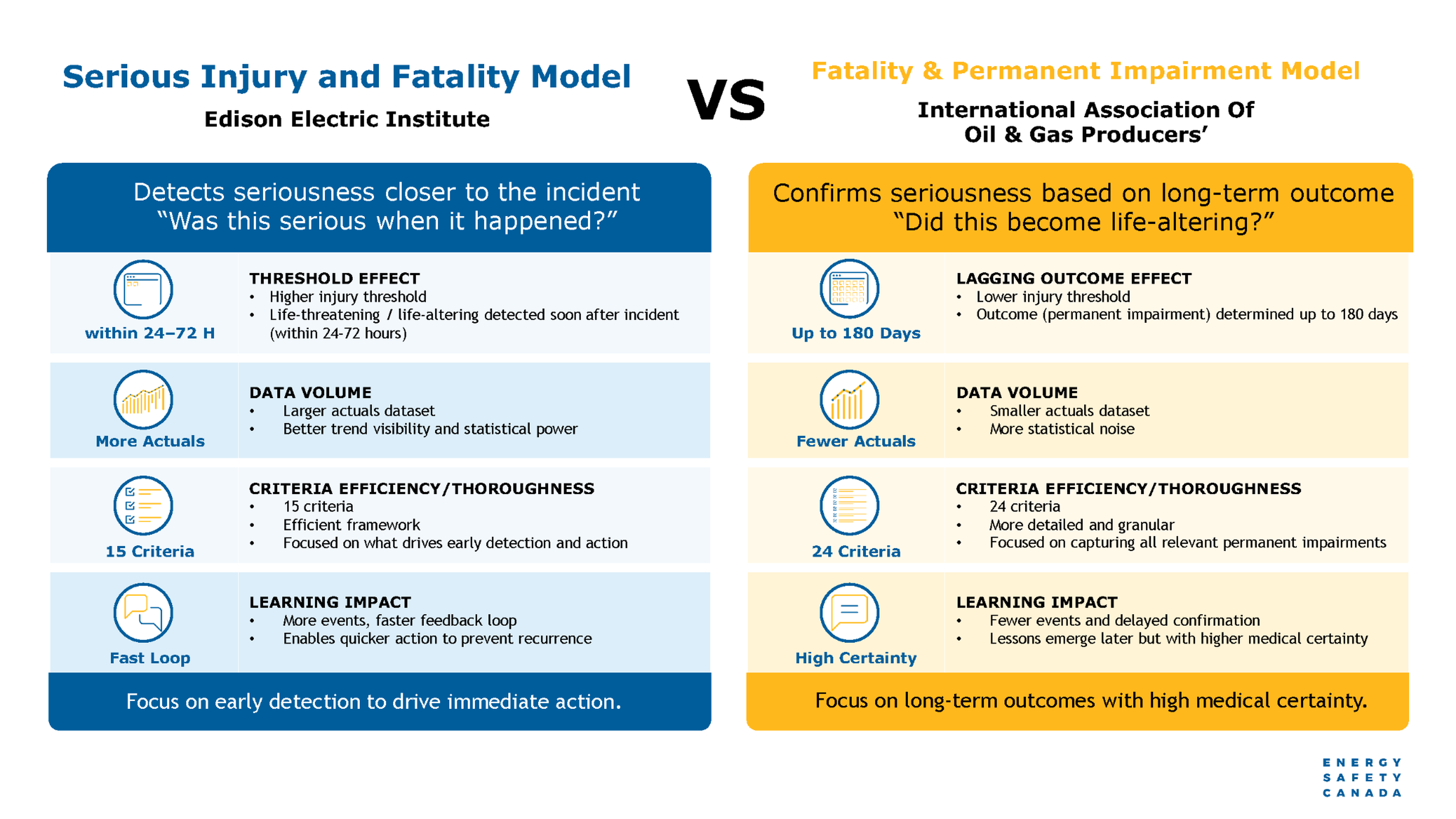
After reviewing five recognized SIF models, the group has narrowed its focus to two leading approaches:
The Edison Electric Institute (EEI) and the International Association of Oil & Gas Producers (IOGP)

The next step is to test both approaches against actual industry data to understand the insights each model provides. This work is not about benchmarking companies. It's about improving learning, identifying critical controls, and preventing future harm.
EEI SIF VS IOGP FPI

What Success Looks Like

A Faster Path From Incident to Action

Our vision is simple.

When a serious incident occurs anywhere in the industry, the learning shouldn't stop with one company.
It should move quickly across the entire system.

Help Build the Industry's SIF Knowledge Base

The effectiveness of this work depends on the willingness of industry to share information.

Every incident shared contributes to a stronger understanding of serious injury and fatality risk.

Every lesson learned creates an opportunity to prevent harm elsewhere.

Submit a Safety Alert