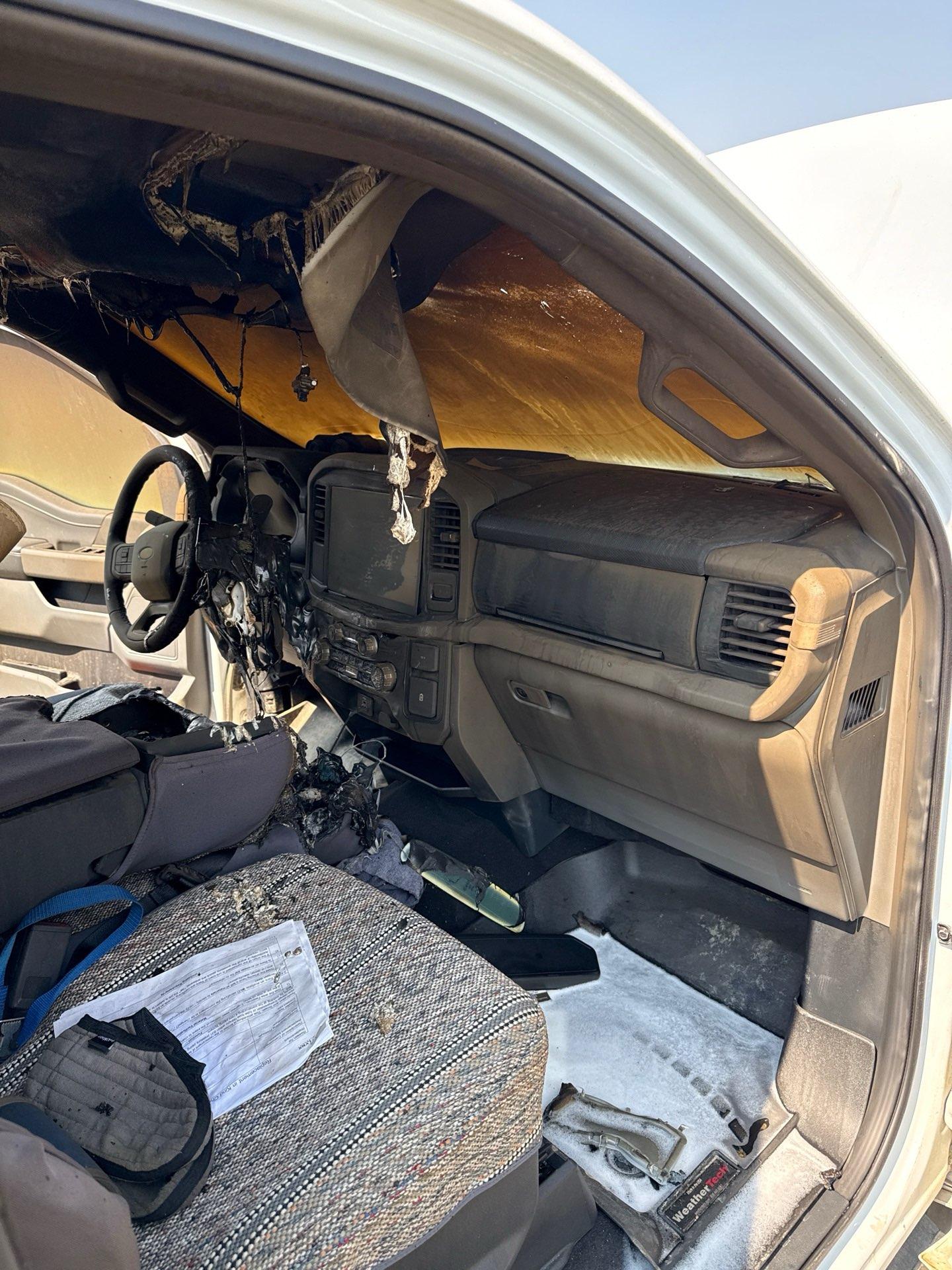
- 911 was called rather than contacting a local department directly. The dispatcher understood the LSD.
- The crew withdrew to the 100 m distance directed by the fire department and staged there.
- The emergency response plan was activated within six minutes of the first phone call, with a wash trailer and bulk water trailer staged to protect the surrounding field.
- Communication was handled by a second person so the operator could focus on the fire, and the landowner was spoken to on scene.
Know What an Extinguisher Can and Cannot Do
Hand extinguishers knocked the flames down repeatedly, but the fire kept returning because the heat and burning material underneath could not be reached. A local volunteer firefighter advised that putting out a vehicle fire typically takes one to three cubic metres of water. Two hand units cannot do that. Once a vehicle fire is established, the objective is to protect people and stop it from spreading, not to save the vehicle.
Before Driving into Crop
Do not drive into standing crop, stubble or tall grass unless it is absolutely necessary, and not without appropriate approval. If the task can wait, be done on foot or be reached another way, that is the expected choice. Where entry is genuinely required, get approval first, travel slowly so material is laid over rather than cut and drawn up, and plan to check and clear the vehicle afterward.
This should be a decision the organization makes with the worker, not one they are left to make alone at the field edge.
Clearing Build-Up Is Itself a Hazardous Task
Getting under a vehicle to remove packed vegetation introduces additional hazards. Before clearing anything:
- Treat components as hot. Exhaust, driveline and brakes stay hot enough to burn long after shutdown and may be hot enough to re-ignite material. Let them cool and wear appropriate gloves and eye protection.
- Put the vehicle in a zero-energy state. Turn the engine off, remove the key, place the transmission in park and set the park brake. Consider disconnecting the battery where the work warrants it.
- Prevent the vehicle from rolling. Park on level ground and chock the wheels. Never rely on the transmission alone.
- Never get under an unsupported vehicle. Do not jack a vehicle without proper stands and do not put yourself anywhere a shift in the vehicle could trap you.
- Manage traffic. Pull well clear of the roadway or lease road, use hazard lights and set out cones or signage. Do not perform this work on a shoulder or active access road with traffic moving past you.
- Use tools, not hands. A blower, compressed air or a hook can reach into places your arm should not go. If material cannot be safely cleared from outside the vehicle, report it and have it handled at an appropriate maintenance location.
- Work with someone where you can and tell someone where you are if you cannot.
What We Are Doing
The fixes for this belong to the organization, not to individual drivers. Following the After-Action Review, actions include:
- A crop-entry approval expectation to make entry into standing crop a planned, approved decision rather than an individual judgment made under time pressure.
- Building clean-out into the work through scheduled checks and cleaning of the undercarriage, exhaust area and radiator during crop season, with time allowed for the work and safe means to do it.
- A seasonal reminder to raise this hazard at operations and safety meetings ahead of each crop season.
- Extinguisher guidance and checks, including physically checking water units for correct fill and charge.
- Reviewing vegetation control and potential equipment changes, such as shielding or exhaust wrap, while recognizing that added shielding can trap more material and make inspection harder.
What You Can Do
- Talk about this hazard at your next tailgate, particularly with anyone new to field work and with contractors and vendors who drive the same fields.
- Get approval before entering crop, and travel slowly if you do.
- Check underneath after crop-season entries, following the precautions above, and report what you find.
- Check your extinguishers physically, not just that they are present. One water unit on scene held water but had lost its pressure.
- Do not rush the response. Driving fast to reach an incident adds a second emergency. Getting there safely is getting there.
- Keep reporting and identify what gets in the way. If checking or cleaning is impractical, slow, or the vehicle makes it difficult, that information is important.
Consistent with Human and Organizational Performance principles, the focus is on the conditions that made these outcomes likely, not on the people who encountered them. As was said in the After-Action Review, “there could be many other operators driving around who are carrying build-up right now”. That is a system to fix, not a person to correct. Error is normal; blame teaches us nothing and costs us the reporting we depend on.