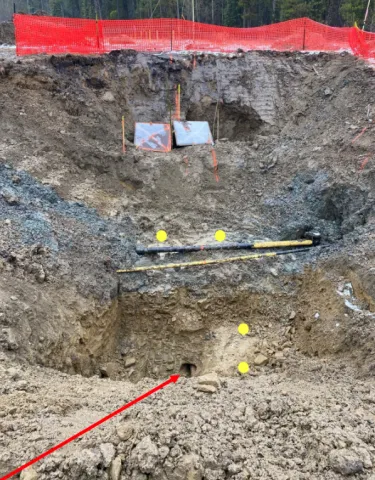
What Happened?
May 9 & 10
A hydro-vac crew began digging slots in dig area to expose the 6” and 10” Company-owned lines.
At 4.6 m depth, the team encountered a shale/sandstone base covering the Company-owned lines.
While attempting to hydro-vac through the shale/sandstone, the slot walls were continuously sloughing in due to the depth of coverage, causing setbacks and delays in the job’s progress.
The Company GD Supervisor stopped the job and contacted leadership to discuss a path forward.
May 11 & 12
A deviation from the Corporate Safe Operating Practice (CSOP) for Ground Disturbance was reviewed and approved by area leadership, requiring the team to box out an area above the Company-owned lines with a hydro-vac.
This allowed them to mechanically dig 2 m of soil from on top of the Company-owned lines to mitigate sloughing when hydro-vacing through the shale/sandstone.
May 16 & 17
The area was successfully boxed out as per the CSOP deviation.
The hydro-vac crew successfully slotted and exposed the Company 6” and 10” lines on the northwest side of the dig area.
The 6” line was found at 5.35 m and the 10” line at 5.15 m.
Area leadership and HSA completed a GD targeted inspection with no gaps identified.
May 18
Hydro-vac completed exposing two third-party lines across the dig area.
Mechanical excavation was started and completed to the depth of the third-party lines across the dig area.
Hydro-vac began removing the shale/sandstone layer, but progress was slow:
- Crews began digging through shale/sandstone with shovels, as they were making better progress with this technique.
- The Company GD Supervisor and third-party Supervisor marked the approximate location of the Company 6” and 10” lines with spray paint on the shale/sandstone, referencing previous line locate markings and exposed lines 5m away.
May 19
The third-party crew was using a Hilti to chip away shale/sandstone while using an excavator to remove the small pieces that came free.
The excavator then began digging in the sandstone, as the workers onsite believed they were more than 1 m away from the Company 6” line.
At approximately 11:00 am, the excavator contacted the 6” line, causing a dent and scrape to the pipe.
What Did We Learn?
Management System – Accountability Needs Improvement
Workers did not follow the Company’s CSOP for Ground Disturbance by conducting mechanical excavation within the Tolerance Zone.
- Tolerance Zone: The area around an underground facility where mechanical excavation is strictly prohibited prior to exposure of the facility within 1 m.
Management System – Employee Communications Needs Improvement
The Company GD Supervisor proceeded with mechanical excavation within the Tolerance Zone prior to the lines being exposed by hydro-vac without communication to their direct supervisor.
What Could Have Happened?
If the line had ruptured, there would have been an H2S release (line operates at 1200 kPa and has approximately 2500 ppm H2S), which could have caused multiple worker fatalities onsite and an uncontrolled H2S release.