What Happened?
A few years ago, gas flow into the facility increased, and the site was looking at ways to increase throughput of the compressor.
- The speed of the unit was increased to 1150 and 1200 revolutions per minute (RPM).
- An increase in compressor vibration coincided with the increase in compressor speed.
- Vibration analysis was completed by a rotating equipment specialist.
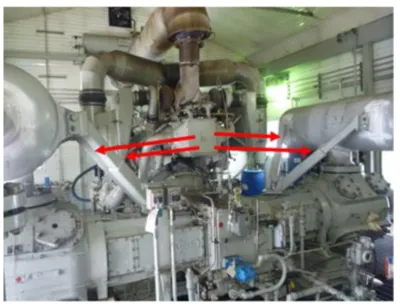
- It was recommended to remove the cross bracing from the suction bottles, as this lowered vibration levels on the compressor cylinders and frame.
- Cross bracing was removed, which improved overall vibration in this running parameter on the compressor cylinders and frame; however, bottle vibration was not measured.
- No Management of Change (MOC) was completed prior to the removal and previous failures modes and studies were not known.
Shortly after, integral vibration alerts were coming in when unit was being sped up above 1000-1100 RPM. Further inspection found that both compressor pistons were cracked. There is a high likelihood that the cracked pistons were also a contributing factor to the previous issues. A vibration engineering assessment was completed, highlighting high vibration on the suction piping and compressor frame.
Approximately one month later, an alarm for Lower Explosive Limit (LEL 10%) detection rang in at the compressor building in the early morning. H2S would also have been present at ~0.25% (2500 ppm). Operations donned appropriate PPE and entered the building to investigate the LEL alarm.
The compressor developed a crack on the north suction bottle due to high vibration, resulting in a gas release.
- Initial cracking through the repad and in the repad-to-shell weld was noted at +/- 18” in length.
- Cracking was found in the shell-to-nozzle weld, once the re-pad was removed, was +/- 10”.
- Through-wall cracking was noted at 2.5” long in the neck of the nozzle.
- All evidence collected identified that without cross bracing installed, K202 suction bottles are prone to cracking every 18-24 months of run time.
What Did We Learn?
Conclusion:
Based on a review of all documentation, the suction bottle failure mode is due to vibration resonance. Resonance occurs when forced vibration (machine RPM) occurs at natural mechanical frequencies. Machinery vibration and pulsation studies highlight this concern with the suction bottles. Resonance can amplify vibration and has a high likelihood of damaging equipment. The crack aligns with vibration-induced fatigue, further supporting the above statements.
Due to the facility history, including scheduled plant suspension plans in 2020, extended plant suspension plans in 2021 and the decision to keep the facility online, a gap was created in key personal and facility support needed to ensure safe, reliable, and adequately maintained rotating machinery assets. This situation resulted in inconsistent third-party vendors, unfamiliarity with equipment history, inconsistent preventive maintenance programs and a lack of consistent engagement with operations and management from a rotating perspective.
- Accountability needs improvement.
- Repeat failure.
- The MOC process was not followed prior to removing compressor suction bottle cross bracing. This had a high likelihood of highlighting previous repeat failures that led to the installation of the cross bracing. Based on the available information, those involved were trained in the MOC process; however, when removing the cross bracing this process was missed.
- Staff did not follow the MOC standard before removing the cross bracing. Although pre- and post-vibration readings were taken and discussions occurred, the MOC process was not followed. Following the process would likely have identified the previous failures.
- Steps were taken previous to the failure to address vibration issues before the failure occurred. Corrective actions were underway; however, information of previous failures and actions were unknown.
- The facility had good past documentation on maintenance history of this compressor in the form of paper reporting stored at the facility.
- A safe response was made by operations to originally detect the leak from the failed suction bottle and shut down the unit accordingly.
Potential Outcome | What Could Have Happened?
- If this event had occurred during daytime hours, there could have been a higher potential for workers to be in the area of the release.
- Had this been a catastrophic failure of the suction bottle, the gas release could have reached an ignition source, resulting in a catastrophic fire or explosion that could have caused serious injury or death to workers onsite and significant equipment damage.
- Workers were in the area could have been exposed to gas levels with up to 2500 ppm H2S (IDLH of H2S is 100 ppm).