

Skip to main content
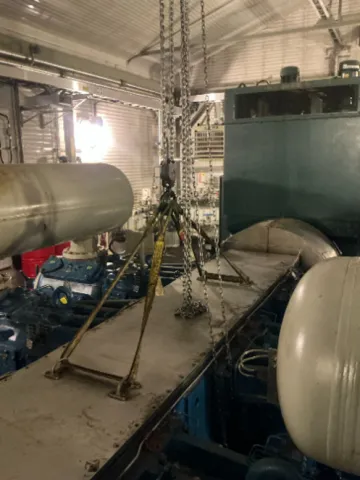
Crankcase Cover hoisting setup

What Happened?

When starting a compressor after a major service/overhaul, the compressor is run unloaded for 5 minutes and then shut down to measure bearing temperatures. The crankcase cover must be removed so a technician can measure bearing temperatures using a handheld infrared thermal gun.

During a recent startup, process gas accumulated within the crankcase. When the crankcase cover was removed, a combustible atmosphere was exposed in the crankcase and immediately next to it. The gas-air mixture was most likely ignited by the technician’s thermal gun, which was not intrinsically safe, resulting in a flash fire.

One worker sustained a minor superficial burn to their hand. The unit was immediately shut down, personnel evacuated the area, and all personnel were accounted for at the muster point.

  • Process gas migrated from the compressor cylinders, through the packing and distance piece, and accumulated within the crankcase.
  • A limited amount of process gas migration into the compressor crankcase is recognized by both the OEM and service providers as an expected operating condition. But current startup procedures don’t address the risks this creates during startup checks.
  • Lifting the crankcase cover to measure bearing temperatures exposed or created a combustible atmosphere in the crankcase.
  • A non-intrinsically safe infrared thermal gun, held near the edge of the crankcase, was identified as the most likely ignition source. infrared thermal guns are commonly used for bearing temperature checks across the industry.
  • Combustible gas concentrations in the crankcase were much higher than technicians expected. Because personal gas monitors sampled a different atmosphere a few feet away (outside the crank case), they should not be relied on to identify hazards at the temperature measurement location. 
  • In this case, static discharge was considered unlikely; however, controlling static ignition sources near the crankcase remains critical, particularly during lifting of the crankcase cover because the cover is no longer ground once suspended in the air.

Submit your safety alert

Help industry by sharing lessons learned from an incident.

Related Learning Opportunities

Share: